Luxury hospitality continues to perform well in 2026, but where that performance is coming from is changing. If you're still measuring your hotel's success primarily through occupancy and ADR, you're looking at an incomplete picture.
Rooms remain important, but in 2026, they are no longer the sole driver of value. Increasingly, luxury hotel ROI is being shaped by how effectively owners and operators position and commercialise their wider offer, particularly across spa, leisure, and experience-led amenities.
For many assets, these areas have historically underperformed or been treated as cost centres. That mindset is becoming expensive.
The hotels generating the strongest returns right now are treating every part of their asset as a defined commercial opportunity. Not as a supporting facility. Not as a guest perk. As a revenue stream with its own pricing strategy, its own audience, and its own performance targets.
We break down how luxury hotels are actually making money in 2026, and how they're utilising their whole portfolio to expand revenue streams.
Luxury hotel trends – what the market is telling us for 2026
The numbers back up the need for luxury hotel owners, operators, and managers to reevaluate their revenue streams and to diversify their offerings.
Savills' 2026 Hotel Sector Outlook makes it clear that while luxury hotels are outperforming the wider market, that performance is not a given. Demand has levelled off in many areas, and the cost of running a hotel, particularly staffing and business rates, keeps climbing. The hotels pulling ahead are doing so through sharper commercial thinking, not just strong demand.
Christie & Co's Business Outlook 2026 tells a similar story. Overall hotel profitability actually dipped slightly in 2025, with the April National Insurance rise and a 6.7% increase in the National Minimum Wage eating into margins across the board. The hotels that held their ground did so by growing total revenue, not just room revenue, and by keeping a tighter grip on costs.
"Growth at the top end of the market is increasingly driven by depth of spend rather than volume of guests. By changing your mindset and seeing your amenities as defined, separate revenue streams and not an extension of your hotel, you can unlock more commercial opportunities."
— Rachael Stevenson, Commercial Director, Michels & Taylor
What do these trends mean for luxury hotel owners?
The structural shift is clear. Guests are spending with greater intent. Expectations are higher, and value is defined less by the room itself and more by the overall luxury experience.
The strongest-performing hotels are responding with clarity. They are:
- Treating spa, leisure, and F&B as standalone revenue streams with dedicated pricing strategies
- Focusing on total spend per guest, not just occupancy rates
- Aligning their positioning with a clearly defined, high-value audience
- Investing in the commercial infrastructure to manage each department as a profit centre
The hotels that have not made this shift are increasingly exposed. Rising operating costs mean that the old model of subsidising underperforming amenities with room revenue is becoming harder to sustain.
At Michels & Taylor, we've seen how these shifts are reshaping the landscape, and we've designed a service that helps luxury brands stay ahead while unlocking new revenue potential. Our Revive Hotel Consultancy Service is built around these evolving behaviours, giving you a clear path to stronger performance and sustained growth.
Discover Revive by Michels & Taylor
Reevaluating your revenue streams: Lessons from a Cotswold turnaround
We've seen firsthand what happens when you apply commercial discipline across the whole asset, not just the rooms. This comes from a luxury 65-bedroom hotel in the Cotswolds within our own portfolio.
Six months after opening, the hotel was operating at a loss. Not because of a poor location or weak demand, but because the commercial model was not structured to capture and convert the opportunity in front of it. The fundamentals were strong. The execution was not.
The work focused on three areas:
- Cost control: Bringing operational costs in line with revenue reality, without compromising the guest experience
- Leadership: Strengthening the management structure to create clear commercial accountability across departments
- Commercial strategy: Introducing pricing discipline, audience segmentation, and a demand generation approach that treated the hotel as a business, not just a building
Within 12 months, the hotel had moved into EBITDA profitability. Nearly ten years on, it remains one of the strongest operators in its market.
The lesson here is not just about fixing a struggling hotel. It is about what happens when you treat every revenue-generating area of your asset with the same rigour you would apply to a standalone business.
This is the mindset shift that separates luxury hotels with strong ROI from those that are perpetually fighting margin erosion. If your spa, leisure club, or restaurant is not performing, the question is rarely whether you have the right facilities. It is usually whether you have the right commercial structure around them.
Learn more about how our hotel management approach has supported countless luxury hotels
How do you position your hotel as a luxury option?
If potential guests do not see you as a luxury option, they will not choose you as one. And they will not pay luxury rates for an experience they cannot clearly identify as premium.
The way hotels communicate their value is being redefined. Positioning is no longer just about marketing. It is a commercial decision that directly affects pricing power, audience quality, and total revenue per guest.
The practical steps to reposition as a genuine luxury option include:
- Auditing how your current messaging compares to what high-value guests actually expect
- Ensuring your physical environment, service standards, and pricing are all telling the same story
- Treating your leisure, spa, and F&B as premium propositions in their own right, not add-ons to the room rate
- Building a membership or loyalty model that creates recurring, high-value revenue independent of room bookings
The leisure transformation case study
One of the most striking examples of this comes from a leisure facility within our portfolio that was attached to an existing hotel. The facility lacked definition. Its positioning was unclear, its membership model was unstructured, and its marketing was not speaking to the right audience. As a result, it was consistently underperforming relative to its potential.
The repositioning involved four interconnected changes:
- Brand identity: Repositioned as a premium, standalone leisure club with a clear proposition, separate from the hotel's general offer
- Membership model: Restructured to reflect the value being delivered, with a more disciplined pricing and retention framework
- Sales capability: Enhanced to convert the right audience at the right price point
- Marketing: Refined to speak to a higher-value audience and reflect the premium positioning
The commercial impact was significant:
| Metric | Result |
|---|---|
| Revenue | +182% |
| Memberships | +120% |
| Payroll Ratio | Reduced from 66% to 38% |
| Gross Operating Profit | +293% |
These results tell us that positioning is not a branding exercise. It is a revenue strategy. When you get the positioning right, you attract the right guests, command the right rates, and create the conditions for secondary spend to follow naturally.
What key revenue streams are growing for luxury hotels?
Revenue today is shaped by a wider mix of experiences, services, and on-property spend, all contributing to total performance in different ways, and the way they look is changing.
The core streams now typically include:
-
- Rooms: The foundation of revenue, increasingly driven by premium positioning, suite categories, and curated packages rather than occupancy alone.
- Spa & Wellness: Rapidly growing as guest demand shifts toward wellbeing, longevity, and personalised treatments. What was once a supporting amenity is now becoming a central part of the guest journey.
- Food & Beverage: Moving beyond hotel dining into destination-led concepts that attract both guests and local audiences, creating consistent, all-day revenue.
- Leisure & Experiences: Fitness, activities, and curated experiences that extend guest engagement and increase overall spend during the stay.
- Specialist Amenities (e.g. Golf, Clubs, Residences): High-value offerings that strengthen brand positioning while unlocking additional, often premium, revenue opportunities.
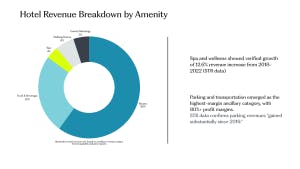
What's changing in 2026 is the balance between these streams. Guests are placing more value on experiences that enhance how they feel, not just where they stay. As a result, areas like spa, wellness, and leisure are growing in importance and moving closer to the centre of the commercial strategy.
This creates a clear opportunity: repositioning these offerings from secondary services into defining features that actively drive revenue.
Unlocking spa revenue: from loss leader to high-value asset
Spas sit at the centre of the luxury proposition for most hotels. They feature prominently in marketing, they influence booking decisions, and they shape guest perception of the overall experience. Yet many hotel spas operate well below their commercial potential.
The problem is rarely the facility itself. It is the commercial model around it. Treatment menus that have not been reviewed in years, retail areas that are stocked rather than sold, staffing that is not aligned with demand patterns, and pricing that has drifted without discipline. These are structural issues, not operational ones.
How to overhaul your spa offering
In one past case, a luxury hotel spa had clear potential but was not structured to realise it. Using Revive Collective, we crafted an approach to uncover the full potential of the spa. This focused on:
-
-
- Refining the treatment mix: Removing underperforming treatments and introducing options aligned with what high-value guests actually want to spend on
- Improving retail conversion: Moving from passive display to an active sales approach, with team training and incentive structures to match
- Aligning staffing with demand: Ensuring therapist availability and scheduling reflected actual booking patterns, rather than fixed rotas that created both over-staffing and missed revenue windows
- Introducing a new income stream: A Spa Garden concept was created as a distinct, bookable experience, generating revenue independently of treatment bookings
-
The results speak to what is achievable when the commercial model is right:
| Metric | Improvement |
|---|---|
| Treatment revenue | +47% |
| Retail sales | +70% |
| Total spa revenue | +50% |
Growth was driven by improved spend per guest and a more coherent proposition. Not by increasing footfall. That distinction matters: the goal was not to put more people through the spa, but to ensure each guest interaction was converting at its full potential.
Across the luxury segment, wellness and spa are accounting for a growing share of total revenue. If your spa is not contributing meaningfully to your EBITDA, the opportunity cost is significant.
How to increase luxury hotel revenue: Our practical strategy
The case studies above are not outliers. They are the result of applying a consistent commercial framework to assets that had the fundamentals in place but lacked the structure to perform. That framework is replicable.
Here is what a practical luxury hotel revenue strategy looks like when it is built around the principles that actually move the numbers.
1. Audit every revenue-generating area as a standalone business
Rooms, spa, leisure, F&B, golf, events. Each of these should be assessed on its own commercial merits: what is it generating, what should it be generating, and what is the gap? Most hotels have never done this rigorously. The ones that have are almost always surprised by where the biggest opportunities sit.
2. Shift focus from occupancy to spend per guest
Occupancy is a vanity metric if the guests you are filling rooms with are not spending across the property. The more valuable question is: what is the total revenue generated per guest, per stay? That number is where the real profitability story lives.
3. Apply pricing discipline across all departments
Pricing drift is one of the most common and costly issues in hotel operations. Spa treatments, leisure memberships, F&B menus, and event packages all tend to drift downward over time without active management. A structured pricing review across every department, aligned to your positioning and your audience, can have an immediate impact on margin.
4. Build commercial accountability into your structure
Revenue performance does not improve without someone being accountable for it. Each department needs clear targets, the right leadership, and a commercial rhythm: daily, weekly, and monthly reviews that keep performance visible and decisions timely.
5. Treat ancillary revenue as a growth strategy, not an afterthought
The most commercially advanced luxury hotels are not just capturing secondary spend from room guests. They are building revenue streams that operate independently: spa memberships open to local residents, leisure clubs with their own brand identity, F&B outlets that attract external diners. This creates revenue that is not dependent on room occupancy, and that materially improves the asset's overall financial performance.
Revive by Michels & Taylor is a consultancy platform designed to apply exactly this kind of commercial rigour. Clients select the areas of support they need, from room revenue management to spa, leisure, F&B, and sustainability, and fees are structured transparently around agreed hours or days per month.
Contact us to learn more about how Revive can drive growth
The overall strategy to make money as a hotel in 2026
Luxury hotel profitability in 2026 is not about filling more rooms. It is about extracting more value from every element of the asset you already have. The market conditions — rising costs, normalising demand, and increasing guest expectations — make the old model of room-led revenue increasingly fragile. The hotels that will perform strongly over the next three to five years are those that have built a genuinely diversified commercial model.
That model has three layers:
-
-
- Layer 1 – Commercial discipline across all departments. Every revenue-generating area of the asset — rooms, spa, leisure, F&B, golf — is managed as a standalone profit centre with its own pricing strategy, performance targets, and accountable leadership.
- Layer 2 – Positioning that supports premium pricing. The hotel's brand, its communications, and its physical experience all need to be telling the same story. If the positioning is unclear or inconsistent, pricing power erodes and the wrong audience fills the gap.
- Layer 3 – Revenue that is not dependent on room occupancy. Spa memberships, leisure club memberships, external F&B revenue, and event income all create financial resilience that pure room-led models cannot provide. This is where the most significant upside sits for most luxury assets.
-
The case studies in this article illustrate what each of these layers looks like in practice.
None of these results required significant capital investment. They required commercial clarity, disciplined execution, and the right expertise applied to the right areas.
To understand where your asset's biggest revenue opportunities sit, download the Revive Collective brochure to see the full framework in detail.